
LGBT+ History Month
To mark LGBT History Month we celebrate the Christian Voices Coming Out oral history project which marked forty years of prophecy, protest and pride from 1976 to 2016.
Christian Voices Coming Out marks forty years of prophecy, protest and pride from 1976 to 2026. Members of OneBodyOneFaith and other groups, as well as committed individuals inside and beyond the churches, worked together for justice, inclusion and compassion, often at significant cost. With support from The National Lottery Heritage Fund volunteers recorded the stories of these pioneers, in their own words. The recordings form part of the Hall Carpenter collection at the The London School of Economics and Political Science. You can listen to the collection, here.
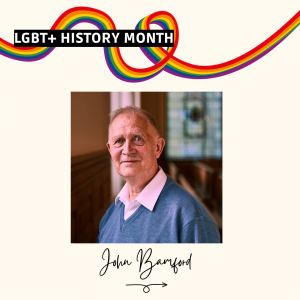
John Bamford (1938-2023) was a long-standing member of LGCM, then OneBodyOneFaith, and a founding member of the London LGBT+ group 3F. John was a secondary school teacher and talented musician and organist.
[LGCM] came along and I wouldn’t say I became a keen soldier for the cause, but at least I felt that having an opinion about it was a worthwhile thing to do. And it was worth being prepared to take risks. For the sake of what I considered to be truth. ...Being in contact with other people who were like-minded, enabled me to think in greater depth about my own background, my roots. Not just about the public aspects of it, which were to do with the law and so on and so forth. But the general attitude in society. And I think I’ve said before that sexuality was not something that was publically discussed, it wasn’t mentioned, and in some ways it was easier to be gay in those days because people weren’t suspicious. Subsequently I’ve felt the need for a more overt approach, a more radical view, and this of course has now come to the fore, the law’s been changed...So it’s a very different story now. It’s a very different world we’re living in. And in some ways it’s a very much happier world. At the same time I still think there’s a long way to go and I’m still very frustrated by the church’s attitude.
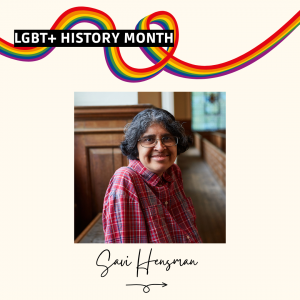
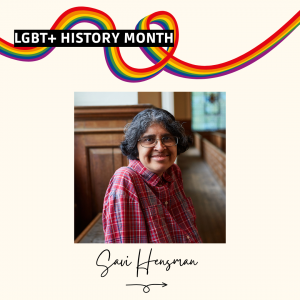
Savi Hensman, a former Chair of OneBodyOneFaith, worked for many years in the voluntary sector, mainly in equalities, health and social care, and is now an involvement coordinator in health research. Savitri helped found London's Black Lesbian and Gay Centre in 1985. You can read Savi's recent DIVA Magazine interview here.
I was elected onto the board of LGCM I think in the early 2000s and one of the things...that I believe maybe has been an impetus for my actions, is that we are the church as well. It's getting people out of that headset that the church is appalling, why should we stay in the church. I mean, I understand that feeling sometimes, when people are really badly treated. You know, in particular congregations, or by a particular leader, and they may just feel they need to get out for safety's sake. But we are the church as well, we are as much part of the church as those who would exclude us and I think it's important for us to claim our heritage, to claim our birth-right, and share the good news if others aren't sharing the good news.

Jim Cotter (1942-2014) was an Anglican priest and one of OneBodyOneFaith’s (then GCM) first members; he described himself as a ‘pilgrim soul’ and ‘wordsmith’, often precariously on the edge of institutions, but with much support and friendship from within. He wrote extensively on prayer, sexuality, HIV and healing, mental health, hospitality and pilgrimage. He returned to parish ministry as parish priest of Aberdaron, RS Thomas’ former parish on the edge of the Lleyn peninsular.
That's when GCM started in April 1976. I think probably human beings, including myself, hurt and were hurt more than they would like to admit, but at the same time recognising that we were stumbling towards something, we weren’t quite sure what we were stumbling towards. I don’t think anybody would even have dreamt of thinking of a phrase like Gay Marriage at that time...
There was a religious television series called Everyman in those days, and Peter France wanted to do a programme on the issue. I was asked to appear on it, which I did, which was more of a changed moment in my life than I probably realised at the time, because it wasn’t the most prudent career move in the Church of England in the mid 70s – it still wouldn’t be forty years on, unfortunately. But … so… that .. that was a big moment of change for me.

Linda Hurcombe is American by birth but has lived in the UK for many years, initially in inner city London and now in rural Shropshire. She has been heavily involved in political feminism, protesting at Greenham Common and was one of the founding members of the Movement for the Ordination of Women.
I’m not a good joiner. But having said that I don’t like joining, I am a campaigner. Along with Sue and several other people, we founded the Movement for the Ordination of Women. And that became quite big and eloquent, and we did other things. Monica Furlong, who was a close friend, she was a broadcaster for the BBC and a wonderful Christian writer. We used to put on cabarets and I used to sing, imitating Joan Baez. And we’d put on things at St James Piccadilly, which were for MOW, but also for sexuality, and understanding sexuality. It was very woven together. For me anyway. Those were really fantastic days. Just lovely putting on these really, really naughty cabarets. You can be really mischievous in theatre, in a good way. Clowns of God.


